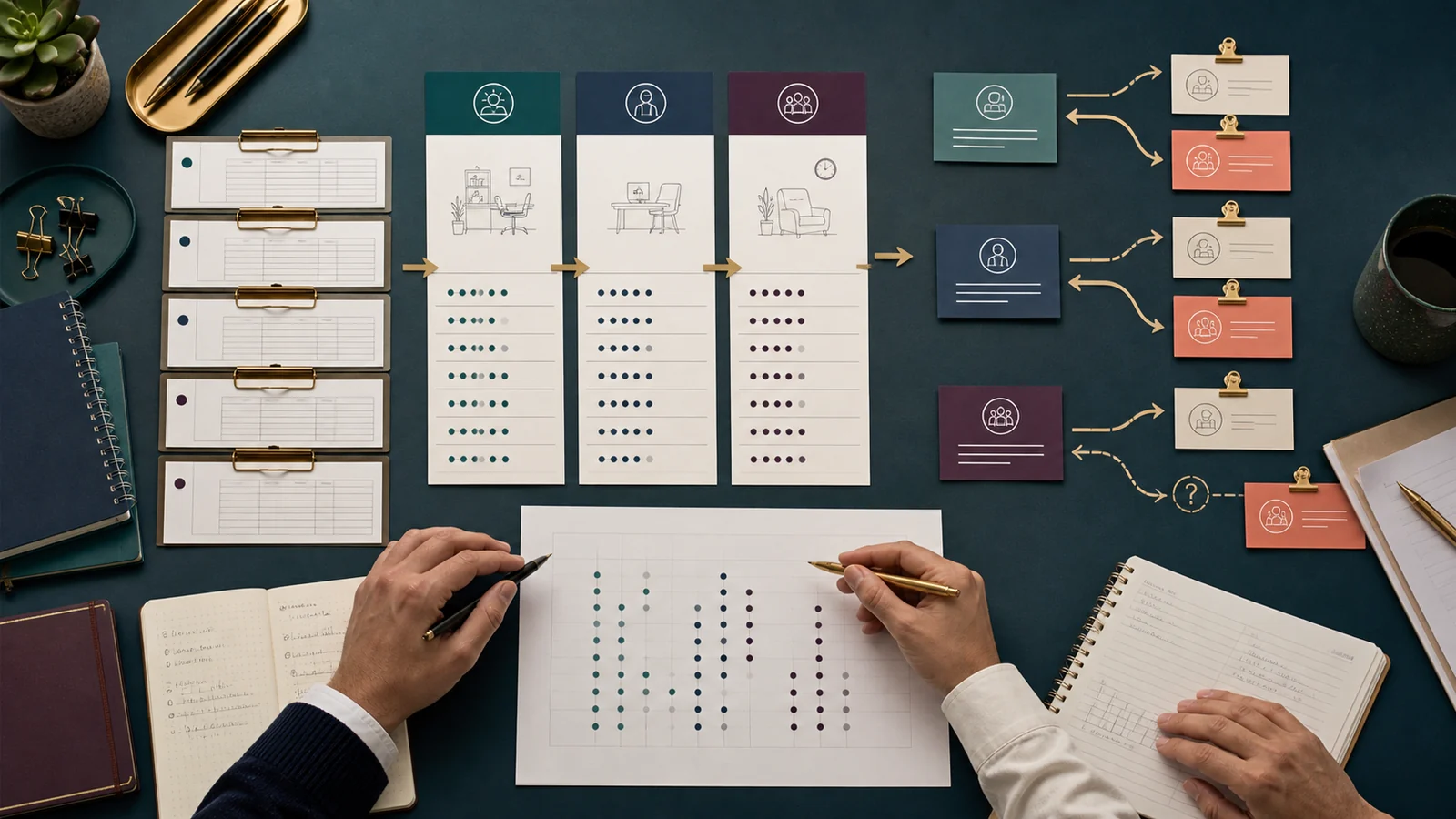
Prompting is a transfer-of-control procedure
The goal is not a prompted correct response. It is for the natural discriminative stimulus to evoke the response under relevant conditions. Response prompts act on the learner’s response; stimulus prompts alter features of the task or cue. Selection should reflect the skill, error history, risk, sensory and motor access, and existing repertoire—not a universal least-to-most or most-to-least preference.
Write the fading plan before the first prompt
Specify prompt type, delay, intensity, who delivers it, the criterion for fading, what happens after an error, and how independent responses are reinforced. Record independent, prompted, and incorrect responses separately. A high percentage correct can conceal complete prompt dependence if these categories are collapsed.
Watch for prompts hidden in adult behaviour
Gaze, body position, repeated questions, proximity, material arrangement, intonation, and waiting patterns can become unintended cues. Conduct probes with unfamiliar instructors, rearranged materials, and natural pacing. If performance collapses, stimulus control may not have transferred even when formal prompts appear to be faded.
Classroom support requires social planning
Continuous adult proximity can interfere with teacher ownership, peer interaction, and student self-advocacy. School support should establish when the classroom teacher cues the student, when peers provide natural models, when the paraprofessional steps back, and how support changes across routines. Fading proximity, prompts, and praise can promote more natural engagement when implemented carefully.
Fading is not withdrawing help on a calendar. It is changing help in response to data while preserving access and success.
Monitor more than accuracy
Track latency, prompt level, error patterns, generalization, maintenance, distress, avoidance, and meaningful participation. If fading produces repeated failure or risk, return to assessment: the prompt may be poorly selected, reinforcement may be weak, the natural cue may be unclear, or the task may need adaptation.